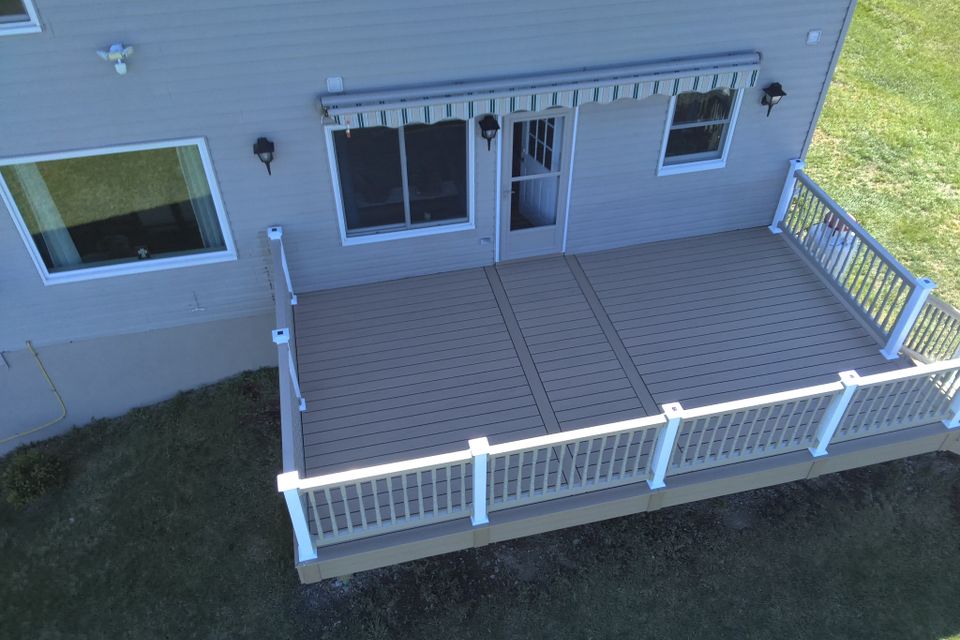
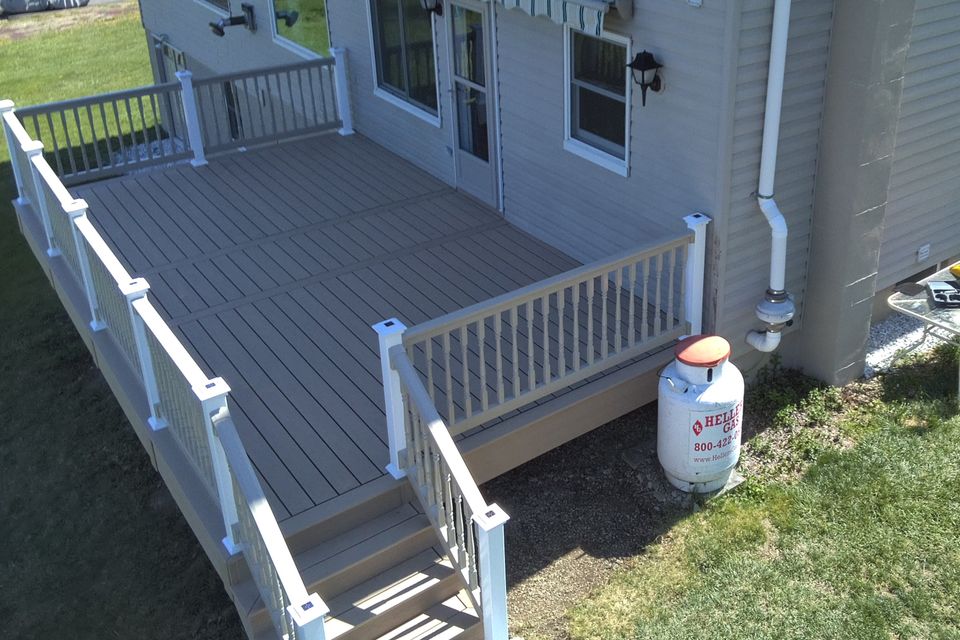
1. How Are They Handling the Foundation? 🏗️This is the question that separates Pocono-experienced builders from everyone else.
Carbon and Monroe Counties have a frost depth of 42–48 inches. That means the ground freezes that deep every winter — and anything sitting in that freeze zone will heave, shift, and eventually fail.
Most contractors pour concrete tube footings. They're cheap, fast, and meet minimum code. They're also vulnerable to frost heave in our climate — which is why you see sloping decks, stair gaps, and railings pulling out of plumb on five-year-old builds all over the region.
At 1st Addition Remodeling, every build uses helical pile foundations — industrial-grade steel piers screwed down past the frost line into stable load-bearing soil. They don't heave. They don't settle. They're the same foundation technology used in commercial construction, applied to your backyard.
When comparing estimates, ask every contractor directly: what foundation system do you use, and why? If they can't explain it in a way that accounts for Pocono winters, that's your answer.
2. What's Their Approach to Moisture? 💧In Northeast PA, moisture is the primary cause of deck failure — not age, not weather, not bad luck. Water sitting on joist tops, trapped behind ledger boards, and cycling through freeze-thaw for years quietly destroys framing from the inside out. Most homeowners don't see it until the deck is already compromised.
Most contractors build to code. Code doesn't require joist tape or structural moisture barriers — it just requires the deck to pass inspection the day it's built.
At 1st Addition, every joist and beam is capped with a professional-grade moisture barrier before decking is installed. We use premium flashing systems at the house-to-deck ledger connection — the single most vulnerable point in any deck build. These aren't upgrades we upsell. They're standard on every project, because building to the minimum in the Poconos isn't good enough.
Ask your contractors: do you use joist tape or structural moisture barriers? What flashing system do you use at the ledger? Their answer will tell you everything about how they think about longevity.
3. Do They Pull Their Own Permits — Every Time? 📋Every deck over 200 square feet in Carbon and Monroe Counties requires a permit. Covered structures, additions, and anything attached to the house require one regardless of size. This is not optional.
Every week, homeowners tell us they got a quote from a contractor who offered to skip the permit and save some money. That shortcut transfers all the risk — legal, financial, and structural — directly to you as the property owner.
When a contractor skips the permit, your homeowner's insurance can deny claims involving the structure. Title searches catch unpermitted work — buyers can walk or demand demolition at your expense. Municipalities can issue fines and require tear-down years after the fact. And the liability stays with you, not the contractor who's long gone.
At 1st Addition Remodeling, we prepare and submit every permit application, communicate directly with your township throughout the review process, attend every inspection — footing, framing, and final — and deliver a Certificate of Occupancy when the project is complete. You never have to chase paperwork or coordinate with a building department. We own the entire process.
4. What Does the Warranty Actually Cover? 🔒Most deck contractors offer a warranty. Very few define what it covers, for how long, or what a defect actually means. When something goes wrong, there's a conversation about whether it qualifies — and that conversation rarely goes the way the homeowner expects.
At 1st Addition Remodeling, every project is backed by the Legacy Guarantee — a written commitment covering structural defects in our installation and craftsmanship. If something fails because of how we built it, we own it. No negotiation. No fine print.
The Legacy Guarantee is built on three pillars: helical pile foundations, our Legacy Protection Protocol for moisture management, and 25 years of hands-on structural expertise in Northeast PA construction. It's not a marketing phrase — it's a documented standard we build to on every project, every time.
5. How Do They Communicate During the Build? 📞The finished deck is what you'll live with for decades. The build process is what you'll remember.
Homeowners consistently report that the biggest frustration during construction projects isn't the final product — it's not knowing what's happening, when things will start, or who to call when they have a question. A contractor who goes quiet once the deposit clears is one of the most common complaints we hear from people who've worked with others before coming to us.
At 1st Addition, every client has a clear point of contact from the first consultation through the final walkthrough. We proactively communicate schedule updates, explain decisions in plain language, and make ourselves easy to reach throughout the project. Our process is structured so you always know what comes next — because a well-built deck and a stressful experience are not a trade-off you should ever have to accept.
6. Are They Building for This Climate — or Just Building to Pass? ❄️This is the question that ties everything together.
The Poconos are not an easy building environment. Freeze-thaw cycles, heavy snow loads, wet mountain soil, and dramatic seasonal swings put real stress on outdoor structures. A deck engineered to barely pass inspection somewhere else won't perform the same way here.
The contractors who understand this build differently from the start. They choose foundation systems that account for frost depth. They engineer framing for actual Pocono snow loads, not the minimum the code requires. They protect moisture-vulnerable connections before there's a problem, not after. And they back all of it in writing.
The contractors who don't understand it — or don't care — build to code and move on. The deck looks fine on day one. The problems show up in year three, year five, year eight. And by then, the contractor is unavailable, unresponsive, or out of business.
The Right Question Isn't "Who's Cheapest?" — It's "Who's Still Standing Behind This in 10 Years?"A deck built to the minimum code in the Poconos will look fine in year one. By year five, the signs start showing. By year ten, you're having a conversation about whether to repair or replace — and the contractor who saved you money upfront is nowhere to be found.
The right deck builder for a Carbon or Monroe County home is one who understands this climate, pulls every permit, builds beyond the minimum, and backs their work in writing.
If that's the standard you're holding your next contractor to, we'd love to be on your list.
No pressure. No pushy sales pitch. Just a straight conversation about what your project needs and what it takes to build it right.
Request a consultation or get an
instant deck estimate — whichever feels easier.